Index
Index of tools mentioned on the bench
Every tool and material that appears in an entry, grouped the way a drawer is arranged rather than alphabetically, with a line on what each one is actually for.
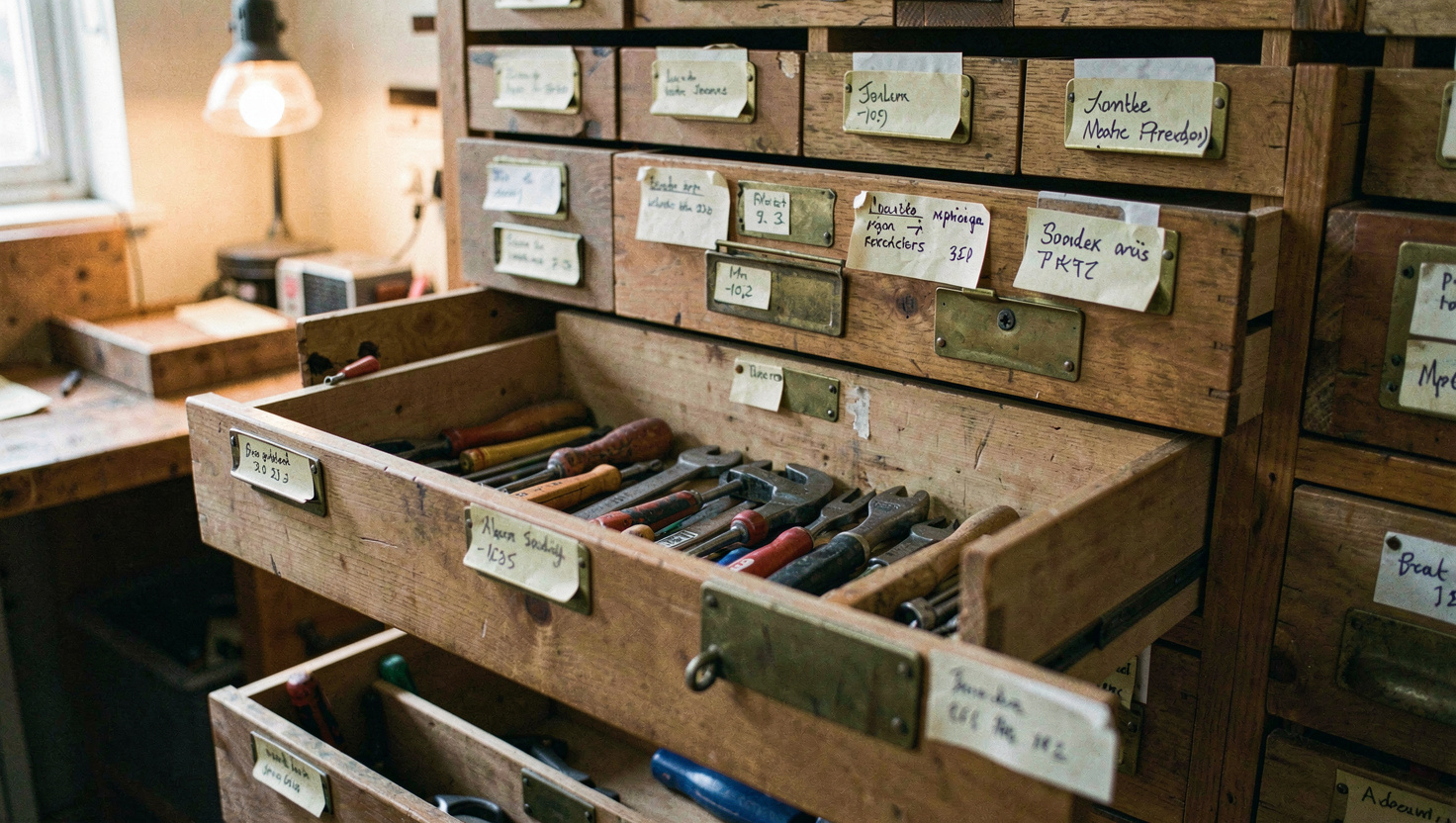
This is a list of every tool and material named in an entry on the bench, with a line on what each one is for and a way through to the job it appears in. It is arranged the way a drawer is arranged rather than alphabetically: things that get picked up together are listed together, because that is how you look for them.
Nothing on this page is a recommendation of a make. Where a particular kind of tool matters rather than a particular brand, such as a white aluminium oxide grinding wheel or vegetable tanned leather for a strop, the property doing the work is named instead. The reasoning behind that, along with the conventions used for grits, measurements and dates, is set out in about the bench.
Edge tools
| Tool or material | What it does, and where it is used |
|---|---|
| Bevel edge chisel | The general purpose chisel for hinge recesses and paring joints. Its whole method is in sharpening a chisel on water stones. |
| Old chisel, ground square | Kept as a scraper for hardened glue on tenon cheeks in the chair reglue, so the good chisels are not used on abrasive residue. |
| Bench plane, number 4 | The smoother, and the tool most worth buying secondhand. What to look at first is in buying an old hand plane. |
| Block plane, low angle | One handed, for end grain and chamfers. It arrives needing forty minutes, which is setting up a new block plane. |
| Spokeshave | Shapes the tongue and the grip of a new handle a shaving at a time, as in rehandling a hammer. |
| Card scraper | Levels a repair flush across two different timbers without dishing the softer one, used in filling a split in a table top. |
| Marking knife | Cuts the shoulder line a butterfly key is pared back to, which is why the key is marked round rather than drawn. |
| Rip saw and crosscut saw | Both are filed at home with one file and two offcuts, in sharpening a hand saw. |
Sharpening kit
| Tool or material | What it does, and where it is used |
|---|---|
| 1000 grit water stone | Cuts the bevel back and raises the burr. The soft one, so it needs flattening before every session. |
| 6000 grit water stone | Polishes both surfaces so the edge is a clean line rather than a ragged one. Wears far more slowly than the 1000. |
| Oilstone | The system that needs no soaking, no flattening and survives a shed below freezing. Compared honestly in oilstones or water stones. |
| Coarse diamond plate | Flattens every other stone in the drawer and never needs flattening itself, which is why it earns its place twice. |
| Leather strop and green compound | Removes the wire burr instead of moving it to the other side, in stropping and the last burr. |
| Bench grinder, white wheel | For chips and reshaping only. The wheel matters more than the machine, as set out in grinding a new bevel. |
| Wheel dresser | Trues a glazed wheel. A glazed wheel rubs rather than cuts, and rubbing is what burns the steel. |
| Triangular saw file | Sharpens saw teeth. Chosen so its face is a little more than twice the depth of the gullet. |
| Flat mill file | Joints a tooth line to one straight line before any gullet is filed, held square in a slotted block. |
| Saw set plier | Bends alternate teeth sideways to open the kerf. Used before filing, never after. |
| Pine offcut | The strop substitute. Drawing an edge once through its end grain pulls the last burr off cleanly. |
Striking, holding and clamping
| Tool or material | What it does, and where it is used |
|---|---|
| Claw hammer, 20 oz | The head outlasts several handles, and fitting a new one takes twenty minutes in rehandling a hammer. |
| Wooden mallet | Drives chisels and knocks joints apart without bruising, always with a softwood block between it and the work. |
| Engineer vice with soft jaws | Holds a hammer head, a saw blade or a door edge. Where it goes on the bench is argued in a bench for a garage. |
| Sash clamps | Close a glue line across a panel or a table top repair. Four is the useful minimum. |
| Cord and a short stick | The tourniquet that pulls a chair frame square, and the clamp that cannot be over tightened. |
| Two plywood offcuts | Clamped either side of a blade in the vice, they make a saw vice that grips the full length. |
Measuring and marking
| Tool or material | What it does, and where it is used |
|---|---|
| Short steel rule | Stood on edge, it finds daylight under a plane sole in the two minutes you get at a stall. |
| Sliding bevel | Sets a grinder rest to 25 or 30 degrees, then the rest is left alone for the whole job. |
| Feeler gauge | Measures a split in a table top twice, a fortnight apart, which is what decides the repair. |
| Soft pencil | Draws the grid on a water stone that shows exactly where the surface is low. |
| Permanent marker | Blackens a bevel or a plane sole so you can see precisely where the abrasive is touching. |
| Masking tape | Numbers every joint of a frame before it is knocked apart, and carries the pencilled measurement. |
| Strip of paper | Finds where a door actually rubs, at fifteen points round the frame, in a door that binds in August. |
Boring, driving and plumbing
| Tool or material | What it does, and where it is used |
|---|---|
| Cordless drill | Pilot holes, clearance holes and wall fixings. Held square to the wall and pulled straight out. |
| Twist drill bits | Two sizes per screw: pilot for the core, clearance for the shank, as in choosing screw gauge and length. |
| Countersink bit | Cut after both holes and only just deep enough for the head to finish level with the surface. |
| Masonry bit | Sized to the plug exactly. Half a millimetre oversize is most of the grip, per the entry on wall plugs. |
| Slotted screwdrivers, three sizes | A driver that fills the slot in width and thickness. Brass screws are ruined by anything else. |
| Adjustable spanner | Wound down tight on a tap headgear nut, in a dripping tap, washer by washer. |
| PTFE tape | Two or three turns on a headgear thread in the direction the nut tightens. |
Materials kept within reach
| Tool or material | What it does, and where it is used |
|---|---|
| Liquid hide glue | Reversible with heat and water, which is why a chair joint gets it. Compared in which joint gets which glue. |
| PVA, D3 rated | The default for carcase work and anything that will be painted. Ruined by freezing in a cold garage. |
| Boiled linseed oil | Three coats on a bare ash handle, wiped off each time, per what actually cures. |
| Beeswax or a candle end | Halves the driving torque on a brass screw, and silences a drawer runner once it fits. |
| Wet and dry paper, 120 and 240 | On float glass, it laps a plane sole or flattens a stone for the price of a sheet. |
| Oily rag | Ten seconds over a rack of tools at the end of a session, which is most of what keeps rust off in an unheated garage. |
What is not on this list
Power tools beyond a cordless drill and a bench grinder, because almost everything in the wood repairs and around the house sections is quicker by hand at the scale a household works at, and quieter at nine in the evening.
If you have arrived here with a tool in your hand and no idea what state it should be in, the two entries that come up most often are sharpening a chisel on water stones and setting up a new block plane. Between them they cover flat backs, bevel angles, burrs and mouths, which is most of what any edge tool asks for.
The tools in this list are put to work in the seven sections, in date order, on the front page.
The day book